COLORBOND® and ZINCALUME® Window Flashings
Window flashing stops water getting into the wall above and below a window. Every window flashing on this page is a Z profile head flashing folded from genuine BlueScope COLORBOND® or ZINCALUME® steel, cut to the length you enter, and delivered to VIC, NSW, QLD, TAS and ACT. Sill flashing, jamb flashing and non-standard profiles are custom flashings, made to order on the custom flashings form.
Built for builders, roofers and owner-builders who need the head flashing to match the window, not the nearest stock length. Get it wrong and water tracks behind the cladding into the frame and plaster; get it right and it is the cheapest part of the window that nobody ever sees again.
How Much Does Window Flashing Cost?
Window flashing online starts at $10.20 per lineal metre for ZINCALUME® and $11.30 per lineal metre for COLORBOND®, GST included. A typical 1.8m window head is $18.36 in ZINCALUME® or $20.34 in COLORBOND®. Because we cut to your length you pay for the metres you use, not a fixed 1.8m or 3m stock length with an offcut. Custom sill trays and jamb angles are quoted from the custom flashings form at a similar per-metre rate.
Window Flashing Sizes and Prices
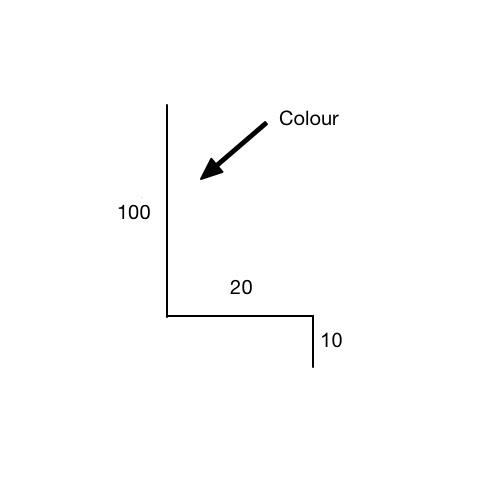
Every window flashing below is a Z flashing in 0.55 BMT steel, priced per lineal metre and cut to your length. The three numbers are the upstand that sits behind the cladding, the projection that covers the window head, and the drip edge that throws water clear of the frame, matching our ZINCALUME® steel window flashings range.
|
Profile (mm)
|
COLORBOND® from
|
ZINCALUME® from
|
|
100 x 15 x 10 Z window flashing
|
$11.30 /m
|
$10.20 /m
|
|
100 x 20 x 10
|
$11.30 /m
|
Custom order
|
|
100 x 25 x 10 window flashing
|
$11.30 /m
|
$10.20 /m
|
|
100 x 30 x 10
|
$11.30 /m
|
Custom order
|
|
100 x 40 x 10
|
$11.30 /m
|
$10.20 /m
|
|
150 x 40 x 10
|
$11.30 /m
|
$10.20 /m
|
|
Prices shown are Victorian, GST included. Select your state on the product page for local pricing. Lengths are supplied with a +200mm / -0mm tolerance, so order the finished length you need, not more. COLORBOND® is available in 21 colours.
|
|
|
Z Flashing, Head, Sill and Jamb: Which One You Need
A window opening has four edges and the water risk is different at each, so window flashing is not one part but three.
Head flashing (Z flashing). Sits over the top of the frame. The upstand goes up behind the building wrap or cladding, the projection covers the head of the window, and the drip edge kicks water away from the frame. This is the window flashing sold by the metre on this page. The Z shape is why a head flashing and a Z flashing are the same product.
Sill flashing. Runs under the bottom of the frame and turns up at each end so water that gets past the window drains out, not into the wall. A sill flashing needs end dams and a fall to the outside, so sill flashings are custom flashings made to your window sizes rather than sold by the metre.
Jamb flashing. Covers the vertical sides of the opening. Often a flexible membrane on lightweight cladding, or a folded steel angle on sheet metal walls. Custom order.
Z flashing is not a drip edge. A drip edge is a roof-edge flashing that guides water off the roof into the gutter. A Z flashing is a wall flashing over an opening or a horizontal cladding joint.
Is Window Flashing Required?
Yes. The National Construction Code requires flashing at window and door openings in every cladding type, brick veneer, masonry veneer and lightweight construction alike, and building surveyors check it on new work. The code sets the minimum extension past the reveals, the turn-up in the cavity, weep hole spacing and how the flashing laps with the building wrap. Those figures depend on your wall type and state, so take them from the current NCC Housing Provisions and the window manufacturer's installation detail, not from a product page.
The steel does its job only if the flashing is installed correctly and in the right order: sill first, then jambs, then head, each lapping over the one below so water always runs onto the outside face of the next layer and never behind the building wrap. Installing flashing out of sequence, or relying on sealant instead of a lap, is a common cause of water ingress at windows. Confirm the detail with your builder or certifier before fixing off. We supply the steel; the installation and compliance sign-off sit with them.
COLORBOND® or ZINCALUME®?
COLORBOND® where the flashing is seen: over windows in weatherboard, sheet cladding and rendered walls, colour matched to the roof, gutter or trim. ZINCALUME® where it is hidden in a brick cavity or behind cladding, at a lower price. Both are BlueScope steel with the same 0.55 BMT and the same profiles, so the choice is appearance and budget, not performance.
Ordering Custom Window Flashings
Pick the profile, choose COLORBOND® colour or ZINCALUME®, enter each length in millimetres, and add to cart. Multiple lengths can go on one line. For sill trays, jamb angles, wider projections or anything not in the table, download the Custom Flashings Order Form, mark up the fold dimensions and email it to sales@metalroofingonline.com.au. Custom flashings are folded from the same steel and colour range, and a custom window flashing costs about the same per metre as a stock profile.
Finish the job from the same order: COLORBOND® roofing screws to fix the flashing, sealants for the laps, apron flashings where a roof meets a wall, and flat sheet if you fold your own.
Delivery
Made to order and dispatched to your location. Metro Melbourne, Sydney and Brisbane typically receive flashings within a few business days of dispatch; regional and Tasmanian orders take longer. Enter your postcode on the product page for the delivery cost before you check out.
Window Flashing FAQs
Is window head flashing required?
Yes. The National Construction Code requires flashing at window and door openings in every cladding type, and a missing window flashing is a defect an inspector will pick up. The dimensions for your wall type come from the NCC Housing Provisions and your window manufacturer's detail.
What is the flashing around a window called?
Head flashing across the top, sill flashing underneath, jamb flashing down each side. In steel, the head flashing is a Z flashing.
What does Z flashing mean?
The profile viewed end-on is a Z: an upstand, a horizontal projection and a drip edge. The upstand goes behind the cladding, the projection covers the window head, the drip throws water clear.
How does Z flashing work?
Water running down the wall behind the cladding hits the upstand, is carried out over the window head by the projection, and drips off the front edge. Nothing reaches the frame or the wall lining below when COLORBOND® and ZINCALUME® flat sheets are correctly folded and installed as Z flashings.
Which size do I need?
Match the projection to the depth of your window head trim: 15 to 25mm for flush sheet cladding and metal frames, 30 to 40mm for weatherboard or timber reveals, 150mm upstand where the wrap lap above needs more cover. When in doubt, follow the window manufacturer's flashing detail.
Can I add window flashing to an existing window?
Yes, if the cladding above the head can be lifted so the upstand goes behind it and the building wrap laps over it. Sealing a Z flashing to the face of the cladding will not last and will not pass inspection. Self adhesive flashing tape can seal the jambs on lightweight construction, but the head still needs a steel window flashing with a drip edge.
What are the common window flashing problems?
Missing window flashing at the sill, head flashing sealed on top of the cladding instead of behind it, no end dams on the sill flashing, and flashings lapped the wrong way so water runs behind the layer below. All four show up months later as swollen timber, damaged frames and stained plaster inside, and the fix means pulling cladding off. Getting the window flashing installed correctly the first time costs a few dollars a metre.
What are the Queensland requirements for window flashing?
Queensland builds to the NCC like every other state, with its own variations and cyclonic-region fixing rules. Your Queensland certifier will confirm the flashing detail for your wind region.
Do doors need the same flashing?
Yes. A door head flashing is the same Z profile; a door sill flashing is made to the wider opening. Order door flashing as custom flashings.
Metal Roofing Online, Mornington, Victoria. Fabricating COLORBOND® and ZINCALUME® flashings and steel roofing sheets for Australian conditions since 2002. Service areas: Victoria, New South Wales, Queensland, Tasmania, Australian Capital Territory.